
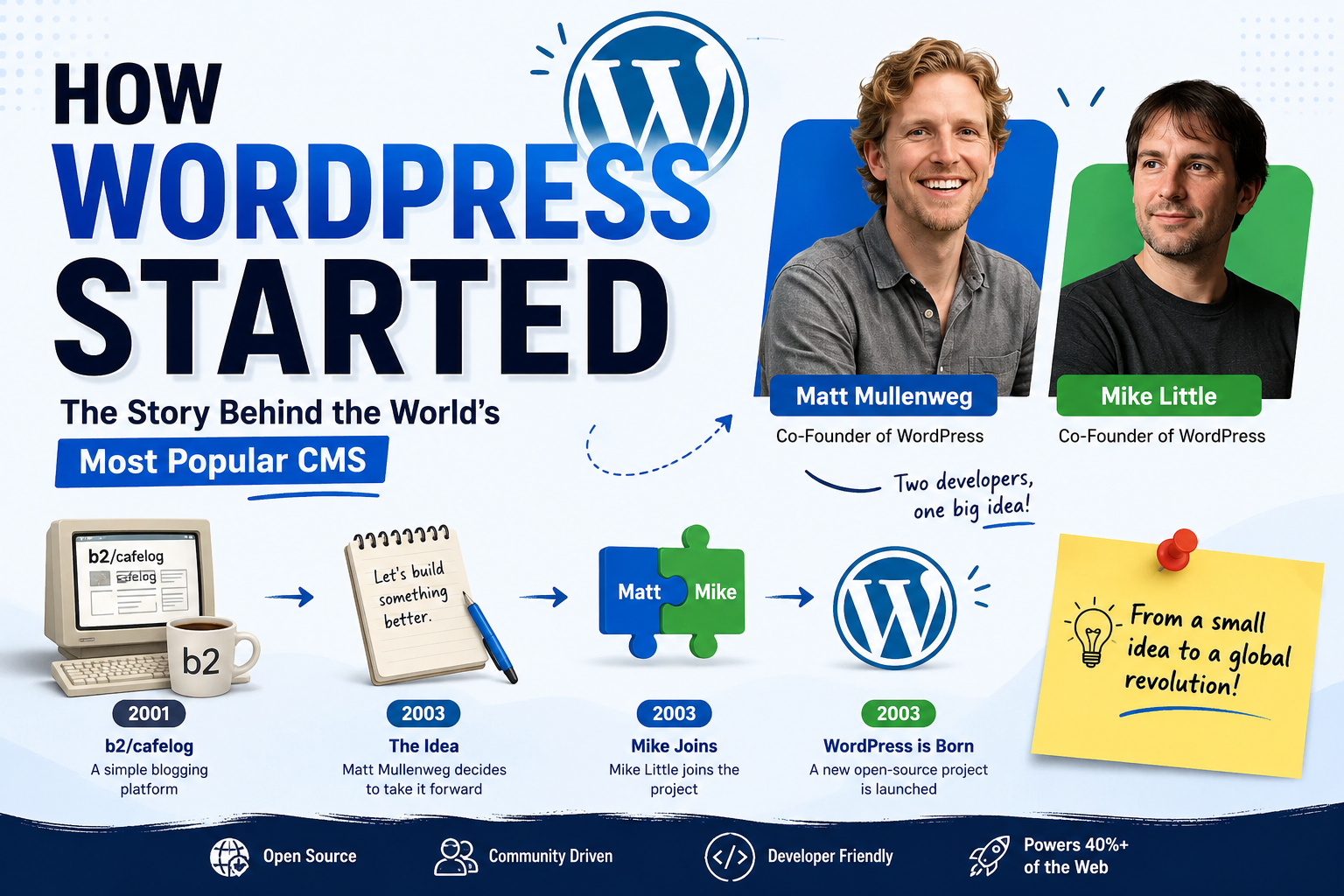
Introduction
Today, WordPress is the most popular Content Management System (CMS) in the world, powering millions of websites ranging from personal blogs and business websites to online stores and educational platforms. Whether you’re a beginner learning web development or an experienced developer building custom WordPress solutions, chances are you’ve used WordPress at some point in your journey.
But have you ever wondered how WordPress started? Was it created by a large software company with a huge budget? Or did it begin as a simple side project?
Interestingly, the story of WordPress is much more inspiring than most people imagine. It wasn’t built by a multinational corporation or funded by millions of dollars. Instead, it started with a simple idea—to improve an existing blogging platform that had been abandoned. Two developers believed that publishing content on the web should be easier, free, and open to everyone. Their passion for open-source software and community collaboration eventually gave birth to what we now know as WordPress.
In this article, we’ll explore how the idea behind WordPress developed, the challenges people faced before its creation, what b2/cafelog was, and how a small project launched in 2003 eventually changed the way websites are built around the world.
The Internet Before WordPress
To understand why WordPress was created, it’s important to look at what the internet was like before 2003.
At that time, creating a website wasn’t nearly as easy as it is today. Most websites were built manually using HTML for structure, CSS for styling, and programming languages like PHP, Perl, or ASP for dynamic functionality. Even making a small change—such as updating a blog post or correcting a spelling mistake—often required editing files directly on the server and uploading them again using FTP software.
This process worked well for experienced developers, but it was frustrating for beginners, writers, and small business owners who simply wanted to publish content online.
Although blogging was becoming increasingly popular, the available blogging platforms were limited. Some were commercial products that required payment, while others lacked flexibility or regular updates. There was no user-friendly system that allowed anyone to create, manage, and publish content without having advanced technical knowledge.
As the internet continued to grow, more people wanted an easier way to share their ideas online. They needed a platform that was simple to use, customizable, and actively maintained. This growing demand created the perfect opportunity for a new solution—one that would eventually become WordPress.
The Problem Before WordPress
In the early 2000s, blogging had started gaining popularity. People wanted to write about technology, travel, education, hobbies, and their personal experiences. However, publishing content online wasn’t as convenient as it is today.
Several blogging platforms existed, but each had its own limitations. Some platforms charged licensing fees, making them inaccessible to many users. Others offered very limited customization options, preventing users from designing websites that reflected their own style or needs. In many cases, developers had little control over how the software worked.
Another major problem was the lack of active development. Some open-source blogging tools stopped receiving updates, leaving bugs unresolved and making them less secure over time. Users who depended on these platforms began to worry about their future because there was no clear roadmap or community support.
For developers, this created another challenge. Since many platforms weren’t actively maintained, adding new features or fixing issues became increasingly difficult. Without regular improvements, the software quickly became outdated as web technologies evolved.
People needed a blogging platform that was free, flexible, regularly updated, and supported by an active community. They wanted software that anyone could improve rather than relying on a single developer or company. This need for a modern, open-source publishing platform became one of the key reasons behind the birth of WordPress.
The Idea That Changed Everything
One of those users was Matt Mullenweg, a college student and blogger who enjoyed writing and using open-source software.
Matt believed that instead of letting the project disappear, someone should continue improving it.
In January 2003, he wrote a blog post expressing his interest in creating a new version based on b2/cafelog. His goal was simple:
- Keep the software free.
- Make it easier to use.
- Allow anyone to contribute improvements.
- Build a platform that could continue growing with its community.
That blog post marked the beginning of what would become WordPress.
What Was b2/cafelog?
Before WordPress existed, one of the most popular open-source blogging platforms was b2/cafelog. It was created by French developer Michel Valdrighi in 2001 and was designed to make blogging much easier than manually creating HTML pages.
Unlike traditional websites, b2/cafelog allowed users to log in to an administration panel, write articles, organize posts, and publish content dynamically using PHP and MySQL. For its time, this was a significant improvement because it eliminated much of the repetitive work involved in maintaining a blog.
The platform attracted a loyal group of users, including students, developers, and technology enthusiasts. One of those users was Matt Mullenweg, who appreciated the software because it was open source and easy to customize.
However, as time passed, development of b2/cafelog slowed down considerably. The project stopped receiving regular updates, and users became concerned that it might eventually disappear altogether. Without active maintenance, fixing bugs, improving performance, or adding new features became increasingly difficult.
Rather than accepting the end of a promising project, some members of the community believed its source code deserved a second life. Since b2/cafelog was released as open-source software, its code could legally be modified and improved by other developers. This opportunity inspired Matt Mullenweg to continue the project instead of letting it fade away—a decision that would ultimately lead to the creation of WordPress
Mike Little Joins the Project
Soon after Matt shared his idea, a developer from the UK named Mike Little responded.
Instead of simply encouraging the idea, Mike offered to help build it.
Together, they decided to fork the b2/cafelog codebase. In software development, a fork means creating a new project using the existing source code while continuing development independently.
This collaboration became the foundation of WordPress.
The First Version of WordPress
On May 27, 2003, the first version of WordPress was officially released.
Although it was a simple blogging platform compared to today’s WordPress, it already included features that made publishing content much easier.
Some of the early features included:
- Writing blog posts through an admin dashboard
- Managing categories
- User comments
- Easy publishing
- Built with PHP and MySQL
Even in its first version, WordPress focused on simplicity and ease of use.
Why the Idea Became Successful
WordPress quickly gained attention because it solved real problems for website owners.
Several decisions played a key role in its success:
Open Source
Anyone could download, use, modify, and improve WordPress for free.
Community Driven
Developers from around the world could contribute code, report bugs, and suggest new features.
Easy to Extend
As WordPress evolved, support for plugins and themes allowed developers to customize websites without changing the core software.
User-Friendly
Unlike many website tools of that era, WordPress was designed for people who weren’t professional programmers.
A Small Project That Changed the Web
What began as an attempt to continue an abandoned blogging project eventually transformed the way websites are built.
Today, WordPress is used for:
- Personal blogs
- Business websites
- E-commerce stores
- News portals
- Educational websites
- Portfolio websites
- Membership platforms
Its success demonstrates how a simple idea—solving a real problem and sharing it openly—can have a lasting impact.
FAQs
WordPress was created by Matt Mullenweg and Mike Little in 2003. They developed it by forking an existing open-source blogging platform called b2/cafelog after its development had stopped.
WordPress was created to continue the development of the abandoned b2/cafelog blogging platform. The goal was to build a free, open-source, and user-friendly content management system that anyone could use to publish content online.
b2/cafelog was an open-source blogging software developed by Michel Valdrighi in 2001. It allowed users to publish blog posts using PHP and MySQL and served as the foundation for the first version of WordPress.
The first version of WordPress (Version 0.7) was officially released on May 27, 2003. Initially, it focused on blogging but later evolved into a full-featured Content Management System (CMS).
Forking means creating a new software project using the source code of an existing open-source project. Matt Mullenweg and Mike Little forked the b2/cafelog project and continued its development under the name WordPress.
Yes. WordPress is completely free and open source. You can download, install, modify, and use it without paying any licensing fees. However, you’ll need a domain name and web hosting to publish a website online.
No. Although WordPress started as a blogging platform, it has grown into a powerful Content Management System. Today, it can be used to build business websites, eCommerce stores, portfolios, membership sites, educational platforms, news websites, and much more.
WordPress became popular because it is easy to use, highly customizable, free, and supported by a large open-source community. Thousands of themes and plugins allow users to create almost any type of website without building everything from scratch.
WordPress is an open-source project maintained by contributors from around the world. While Matt Mullenweg co-founded WordPress and is closely associated with its development, no single person owns the WordPress software itself.
The story of WordPress shows that solving a real problem, embracing open-source collaboration, and continuously improving a project can lead to remarkable success. It reminds developers that even a small idea can grow into software used by millions of people worldwide.
Conclusion
WordPress wasn’t created by a large corporation or through a massive investment. It started because two developers recognized that a useful open-source project deserved to continue.
Their decision to build upon an abandoned blogging platform resulted in software that has helped millions of people publish content online.
Whether you’re a beginner learning web development or an experienced developer, the story of WordPress is a reminder that great ideas often begin by improving something that already exists.
Final Thoughts
As someone learning or working with WordPress, understanding how it started gives you a deeper appreciation of the platform and the open-source community behind it. The next time you build a WordPress website or develop a plugin, remember that it all began with a simple idea: make publishing on the web easier for everyone.

